Outdoor venues, multi-building estates, and barn weddings all share one challenge: getting guests from the parking lot to the ceremony to the reception without anyone wandering. Each design is fully editable in our free browser-based editor for ceremony this way signs, reception signs, parking signs, restroom signs, cocktail hour signs, and custom arrow signs. Most templates are sized at 8x10 or 11x14 inches for stake or easel display, with larger 16x20 options for major directional moments. Coordinate a complete sign set across your venue so guests can navigate confidently. Filter by style below to match your wedding aesthetic.
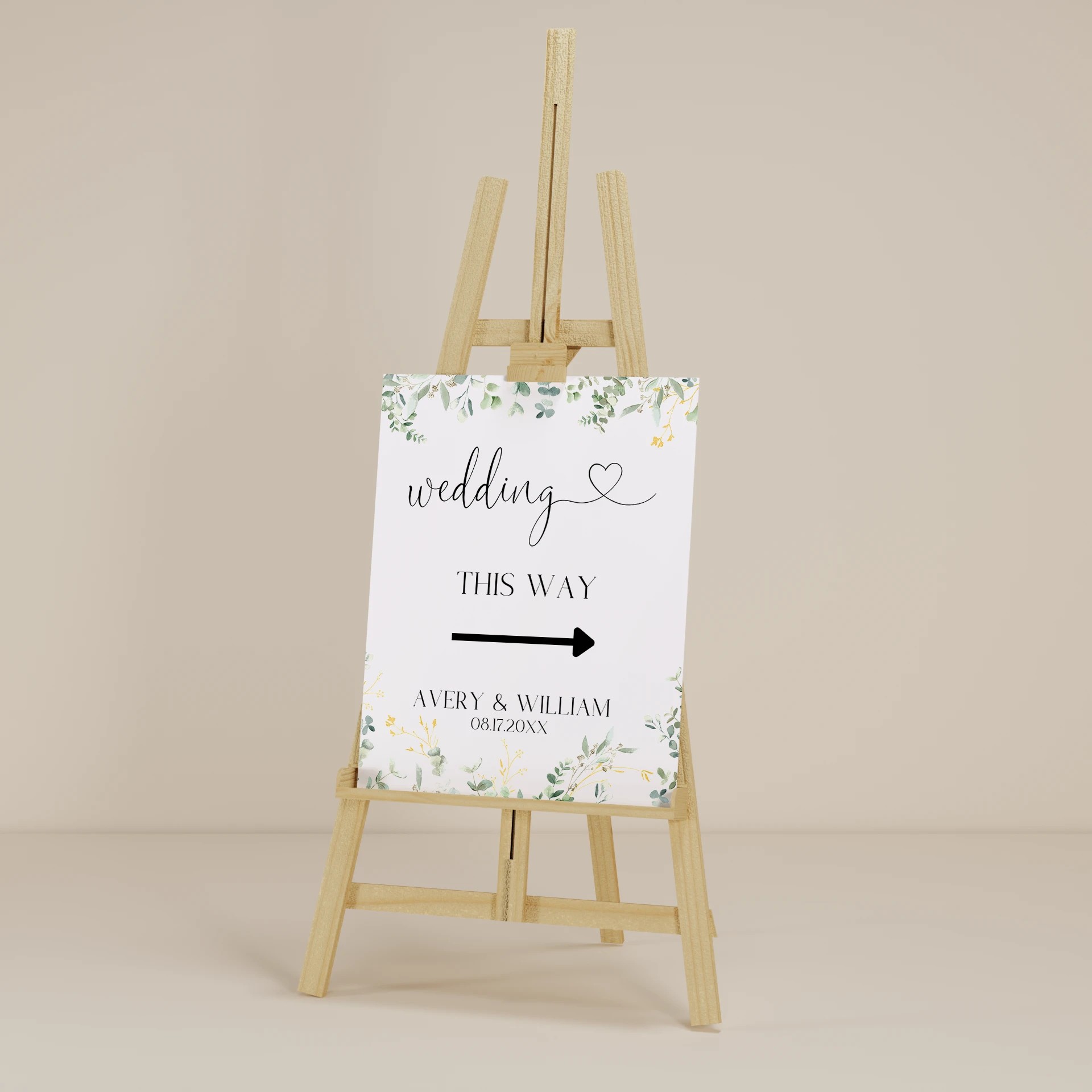
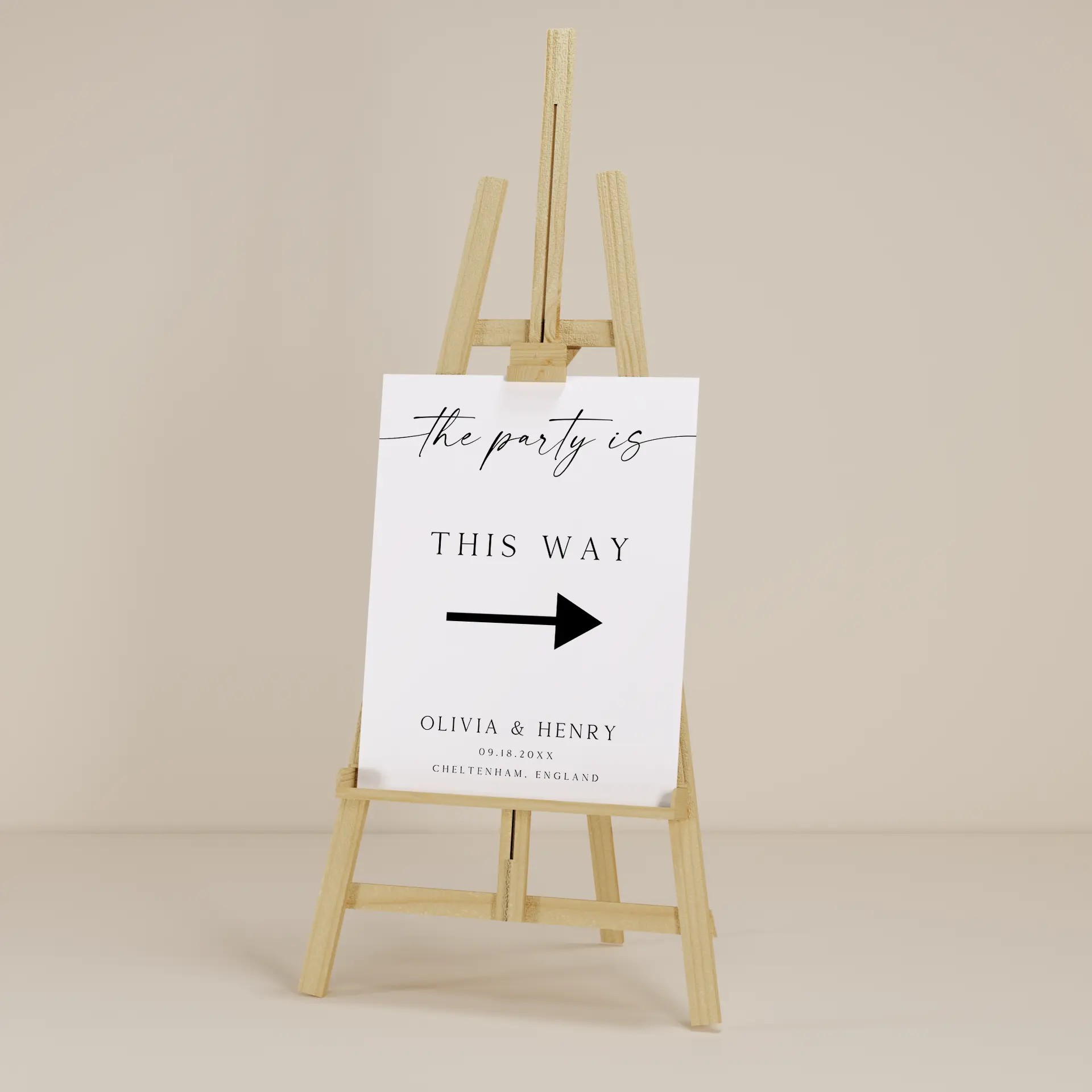
Wedding directional signs help guests navigate your venue, especially at outdoor weddings, ranches, vineyards, gardens, and any venue where the ceremony and reception are in different locations. They tell guests where to park, which way to walk for the ceremony, where the cocktail hour is being held, where to find restrooms, and how to get from one space to the next. Our wedding directional sign templates are fully editable in our free browser-based editor. No Canva account, no Photoshop, no software to install. Customize each sign with your specific text (Ceremony This Way, Reception, Parking, Restrooms, Cocktails), arrows pointing in the right direction, and any decorative elements. Whether you are searching for printable wedding directional signs, an editable wedding venue sign template, wedding arrow signs for an outdoor ceremony, or a complete coordinated directional sign set for a multi-building venue, every template here is built to be customized in your browser and printed at home or at any local print shop. Most templates are sized at 8x10 or 11x14 inches for stake or easel display, with larger 16x20 options for major directional moments at the venue entrance.
Clean lines, modern serif typography, and generous white space. For weddings with a contemporary or modern aesthetic.
Watercolor florals and soft botanicals. Pairs with garden weddings, vineyard receptions, and floral wedding suites.
Earthy textures, terracotta tones, and hand-drawn details. Great for outdoor and desert weddings.
Formal typography and traditional layouts. Ideal for ballroom receptions, country club weddings, and black-tie events.
Warm wood tones and hand-lettered scripts. Perfect for barn weddings and farmhouse-themed celebrations.
Most weddings use 3 to 8 directional signs depending on the venue layout. Pick the sign types your venue actually needs:
Ceremony This Way. Points guests from the parking area or venue entrance toward the ceremony location. The most common directional sign because most guests do not know where the ceremony is being held until they arrive. Place at the path entrance, intersections, or at the venue entrance.
Reception This Way. Points guests from the ceremony space toward the reception space. Critical for venues where the ceremony and reception are in different rooms or buildings (or even outside vs inside). Place at the ceremony exit and any decision points along the path.
Cocktail Hour. Points guests to the cocktail hour location after the ceremony, especially if it is in a different space than the reception. Often combined with the Reception sign at a decision point.
Parking. Directs guests where to park when they arrive at the venue. Most common at outdoor venues, ranches, and private estates where parking is not obvious. Place at the venue entrance and at any turn-offs.
Restrooms. Points guests to the restroom location, often a discrete sign placed near the reception or ceremony space. More important at outdoor venues with portable restrooms or at large venues where restrooms are not adjacent to the main spaces.
Custom arrow signs. Generic arrow signs with your venue name or wedding hashtag, pointing toward the next space. Useful when the wedding has multiple stations (welcome cocktails, ceremony, dinner, dancing) and guests need help moving between them.
Welcome / venue entry. Different from a wedding welcome sign at the venue door, this is a sign placed where guests turn off the main road into the venue driveway, often at outdoor and rural venues. Tells drivers they have found the right place.
Directional signs are most useful at certain venue types. If your venue fits one of these descriptions, plan for at least 4 to 6 directional signs:
Outdoor and rural venues. Ranches, vineyards, private estates, gardens, and farms where the property is large and guests do not know where to walk. Often the ceremony is in one corner of the property and the reception in another.
Multi-building venues. Resorts, country clubs, and venues with separate ceremony and reception buildings. Guests need help moving between buildings.
Barn and farm weddings. Ceremony often happens in a field or under an arbor, reception inside the barn. Guests do not know which way to walk without signage.
Beach and waterfront weddings. Ceremony on the sand, reception at the venue tent or restaurant. Beach venues are notoriously hard to navigate without clear signage.
Park, garden, and public space weddings. Public venues without dedicated wedding signage need couples to provide their own.
Indoor weddings at hotels, ballrooms, and traditional reception halls usually do not need directional signs because the venue staff guides guests directly to the room. Skip directional signs at these venues unless the venue has multiple rooms guests might confuse.
Walk through the venue with your wedding planner or venue coordinator 4 to 6 weeks before the wedding to identify decision points where guests will need help (parking entry, path to ceremony, ceremony to reception, restroom routing).
Make a list of every sign you need, with the exact text for each (Ceremony This Way, Reception, Parking, Restrooms, etc.). Most weddings need 3 to 8 signs.
Pick a template family that matches your wedding invitation suite. Filter by style above (Minimalist, Floral, Boho, Classic, or Rustic).
Open templates in our free browser-based editor. Customize each sign with the exact directional text and arrow direction. Pull color codes from your wedding suite for visual consistency across all signs.
Choose your sizes. 8x10 inches works for most directional signs on small stakes. 11x14 inches is better for major decision points. 16x20 is reserved for the venue entrance sign or the most important directional moment.
Print at home for small signs (8x10 or 11x14 fit on home printers). Send larger files (16x20+) to a local print shop for foam board mounting. Acquire wooden stakes ($2 to $5 each) or small easels ($15 to $30 each) for outdoor display. Set up signs 1 to 2 hours before guests arrive.
Wedding directional signs work best as part of a complete venue signage suite. Most couples coordinate them with matching wedding welcome signs at the venue entrance, wedding programs at the ceremony, and seating charts at the reception entrance. For dinner table signage, see our place cards, table numbers, and menus. Browse the full Ceremony & Reception Essentials collection for the complete day-of stationery suite.
Most weddings use 3 to 8 directional signs depending on the venue layout. A typical outdoor wedding might need a parking sign at the entrance, a ceremony this way sign at the path entry, a reception this way sign at the ceremony exit, a cocktail hour sign at the reception entry, and a restrooms sign near the reception. That is 5 signs. Add 2 to 3 more if your venue has multiple buildings, a long driveway, or unusual layout. Indoor weddings at hotels and ballrooms usually do not need directional signs because venue staff guides guests directly.
Most wedding directional signs are 8x10 or 11x14 inches and displayed on small wooden stakes or stands. Use 8x10 for minor directional signs ("Restrooms," "Cocktails") and 11x14 for major ones ("Ceremony This Way," "Reception"). For the most important directional moment (often the parking entrance or the path to the ceremony), 16x20 inches on an easel makes the sign visible from a distance. Match the size to the importance of the directional cue and the distance from which guests will read the sign.
Yes for smaller sizes. 8x10 and 11x14 directional signs print at home on heavyweight 100lb to 110lb cardstock with most home printers. For 16x20 or larger signs, send the file to a local print shop because home printers max out at 11x17 inches. Print shops typically charge $15 to $35 for paper printing and $35 to $65 for foam board mounting on larger signs. For outdoor weddings, mount printed cardstock signs on foam board to prevent warping in humidity, then attach to wooden stakes.
Standard wedding directional sign text uses short, clear phrases with arrows. Examples: "Ceremony This Way ->," "Reception ->," "Parking <-," "Restrooms," "Cocktails This Way ->," "Welcome to Our Wedding" with an arrow at the venue entrance. Add the couple's first names or wedding hashtag if you want a personal touch. Keep the text short (3 to 5 words maximum) so guests can read the sign while walking past. The arrow direction is just as important as the text.
Print directional signs 1 to 2 weeks before the wedding. Wait until you have walked through the venue with your wedding planner or coordinator and confirmed the exact placement and arrow direction for each sign. Avoid printing more than 4 weeks ahead in case you change a placement decision. For outdoor weddings, also acquire your wooden stakes or easels before the wedding so you can test how each sign stands up before the day.
The two most common outdoor display methods are wooden stakes (insert directly into grass or soft ground) and small portable easels (work on hard surfaces like patio or driveway). Wooden stakes cost $2 to $5 each at craft stores and can be glued or stapled to the back of foam-board-mounted signs. Easels cost $15 to $30 and are reusable. For windy outdoor venues, foam-board-mounted signs on wooden stakes are more durable than paper signs in frames. Test sign stability the day before in expected weather conditions.